
agriculture
Showing posts with label agriculture. Show all posts

From moringa to cinnamon, Sekaya highlights local superfoods and supports Filipino farmers

Wednesday, October 11


The brand’s partnerships aim to push benefits and help extend availability to consumers 

Sekaya’s long-standing partnership with the Moringaling Philippines Foundation, Inc. (MPFI) has not only produced a high quality moringa supplement but has also contributed significantly to the development of a globally competitive Philippine moringa industry. 

Malunggay, familiar and beloved by Filipinos, is many things: a galactagogue to help boost milk production for breastfeeding moms, a nutrient powerhouse with vitamins C and A, calcium and potassium, and a rich source of disease-preventing antioxidants, amino acids, and anti-inflammatory agents. 

The Filipino plant-based brand under Synnovate (the natural products division of Unilab) produces an EU-certified organic moringa supplement, keeping its sourcing 100% local through farms under the MPFI network which pushes the research, development, and standardization of moringa grown in the country. Sekaya Organic Moringa’s impact covers consumers who reap the benefits of this local superfood, and farming communities that benefit from the support and promotion that showcases local farmers’ capability in organic moringa farming. 


“We are extremely proud to partner with Sekaya in providing the local market with a high quality moringa supplement that is safe for anyone who takes it,” says Bernadette “Bernie” Estrella Arellano, founder and chairperson of Moringaling Philippines Foundation, Inc. ''Through this partnership, we are also showcasing the capabilities of our very own Filipino organic malunggay farmers who meet the stringent standards of international bodies like the European Union.'' 

Aside from big retailers like Mercury Drug and Watsons, and e-commerce sites Lazada and Shopee, Sekaya proactively works on getting its moringa supplement into more distribution channels, particularly provincial ones like Carlos Superdrug in Lucena City, Quezon, and Jhunbelle Drugstore in Coron, Palawan. 

Recently, Sekaya and RiteMed Philippines inked a Memorandum of Understanding (MOU) with social enterprise Plantsville Health to save 16 native cinnamon species, encourage farming of the local spice, and develop natural health products to boost the industry. 

Cinnamon is one of the most important spices used all over the world, and at one point in Europe, considered at par with how oil is valued globally today. Studies have shown that cinnamon may help control blood sugar by making insulin efficient, moving glucose to cells. It is also known to have other medicinal benefits for its antioxidant, anti-inflammatory and anti-microbial properties. 

According to Plantsville Health founder November Canieso-Yeo she discovered that the country not only has its own local cinnamon species, but these are also in the threatened species list of the International Union of Conservation of Nature (IUCN). 

“It’s a shame because our country imports more than 95% of its current cinnamon consumption. How meaningful it could be if we could help grow back the Philippine cinnamon, while earning for the farmers and its suppliers,” she says. 

That’s the aim of Canieso-Yeo’s social enterprise – save the Philippine cinnamon and other aromatic indigenous species by planting them in partnership with small landholder farmers, buy their produce, and develop these into healthful products for consumers. And with collaborations and support from brands like Sekaya and RiteMed, she sees more concrete ways forward. 

“To be able to direct the supply of cinnamon for natural health products to local sources would be a big win for the industry,” Kamille Iris Abapo, Marketing Manager of Synnovate, points out. “As a brand, Sekaya continues to work hard to support local farmers and suppliers while developing high quality natural health products that help set standards for the industry and benefit consumers, community and country.”

With partnerships that benefit Filipino consumers and emerging Filipino enterprises whose businesses support local resources, Sekaya continues to champion the power and health benefits of native superfoods to help optimize our own natural resources for both local and global markets. 

Sekaya is under Synnovate, the natural products division of UNILAB. Learn more about how you can benefit from Sekaya’s plant-based solutions and get health tips and information at https://www.sekaya.com.ph/ and by following @sekayaph on Facebook and Instagram.



Read More

UBX, Oh Crop! partner to introduce sustainable agri financing to Adlai farmers

Wednesday, April 13

 adlai farmers

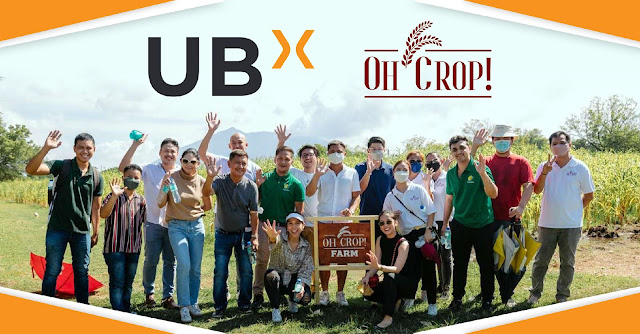
UBX, the leading open finance platform in the Philippines, and Oh Crop!, the country’s #1 Adlai rice brand, have partnered to democratize access to agricultural value-chain financing for rice farmers nationwide. 

Through this first-of-its-kind partnership, SeekCap, the digital lending marketplace venture of UBX, will be able to extend sustainable agri financing to Oh Crop! Adlai rice farmers to expand their operations and gain higher yields. 

Founded and led by chief executive officer Rose Tolentino, chief operating officer Chari Trinidad-Mendoza, and co-owner celebrity chef Marvin Agustin, Oh Crop! assists rice farmers – from choosing the right seeds to plant to selling them to a wider marketplace – in shifting to farming Adlai.

“Our partnership with UBX allows us to provide rice farmers with a suite of technology-based services starting from seed selection to sustainable agri value-chain financing. Adlai has become a popular alternative to our staple rice and we expect the demand will continue to grow. Our partnership will enable rice farmers to shift to Adlai and empower existing ones to expand their operations,” Tolentino said. 

Introduced at the height of the pandemic in 2020, Oh Crop! has become the leading Adlai rice brand in the country, being present in major online marketplace platforms as well as having retail stores in malls in Metro Manila.

“With UBX as our partner, we are confident that we will be able to further accelerate our growth. By joining hands with the leading open finance platform in the Philippines, we can strengthen initiatives that empower farmers with the right tools and knowledge, while giving them wider access to financing,” Trinidad-Mendoza said. 

In 2021, Oh Corp! recorded a whopping 1,000 percent growth in sales, benefiting more than 50 farmer partners (individuals, groups and their families) throughout the country. 

“Our goal at UBX has always been to include everyone and we believe that this partnership will Oh Crop! advances that purpose by bringing financial services — initially through SeekCap — closer to farmers, one of our nation’s unsung heroes,” UBx Managing Director for Banking and Lending Services Anne Yosuico said. 

SeekCap, which was named as the Best SME Loan Product at The Asian Banker: 20th International Excellence in Retail Financial Services Awards in 2021, simplifies the processing of business loans through its digital platform.

Business loans may be processed in as fast as 24 hours, which is significantly faster than the minimum 30-day approval time for most banks. 

In 2021, SeekCap processed over P6 billion in loans from more than 22,000 MSMEs nationwide.

“For us at UBX, equipping MSMEs, including our farmers, with financial tools and services is vital in economic growth and recovery — that is why we continuously implement strategies that democratize access to finance in many parts of the country through our pioneering open finance platform,” Yosuico said.
Read More

Farming and backyard gardening to survive during pandemic

Wednesday, September 9

Kabalikat Sa Kabuhayan program


Two SM Foundation Kabalikat sa Kabuhayan Program graduates in Antipolo City tell their stories

Boso-Boso is an outskirt of the City of Antipolo in Rizal. It is a growing rural community with farm lands at the foot of the Sierra Madre Mountains. Residents in the community were beneficiaries of the SM Foundation Kabalikat Sa Kabuhayan program in February to May of 2016.

One of the beneficiaries is Edgar Moreno, a resident of Boso-Boso and owns a vegetable farm within the community. Prior to his KSK training, he always had challenges in keeping his crops and produce healthy. After three months of weekly trainings, Edgar effectively applied his learning on his own farm. He has then grown his produce to several hundreds of kilos even a ton of vegetables. For the past four years, he has been supplying fresh vegetables to several markets in Marikina, Pateros and Pasig.


Kabalikat Sa Kabuhayan program


Meanwhile, in downtown Antipolo City, in Barangay Mambugan particularly, most land areas are occupied by residences and commercial establishments. Unlike in Boso Boso, residents can maintain pocket gardens on their rooftops or in front of their homes. Hiyasmin Baling, a hair dresser, joined the Kabalikat sa Kabuhayan Urban Gardening training in 2019 in search for new learning and skill. Since then she had continued gardening at her own rooftop when there aren’t customers in her shop.

At the onset of community quarantine started in March 2020 brought about by the Covid-19 pandemic, both Edgar and Hiyasmin felt the effects of social restrictions as their usual volume of products and customers dwindled. Edgar’s usual produce of hundreds of kilos to a ton of vegetables have decreased into several kilos as his byaheros were halted due to checkpoints and difficulty of travel. Hiyasmin’s shop also had to close per mandated restrictions by the national government.

Despite difficulties, Edgar maintains his regular coordination with his byaheros and expanded his reach to local markets in Cogeo and Antipolo Bayan. He still sells less than what he is used to but it did not stop him from overcoming this limitation. He is due to harvest upo, ampalaya, sili and okra at the end of this year. Hiyasmin, on the other hand, now concentrates to her new found livelihood, which is selling plants from her rooftop. She sells seedlings of strawberry even, alugbati, talbos ng kamote, basil and blue ternate. She also sells anti-radiation plants and bonsais. These plants are selling like pancakes as gardening is now in demand in the market.

Edgar and Hiyasmin may have been facing adversities like the rest of us but their resiliency which they have learned through SM Foundation’s Kabalikat Sa Kabuhayan has given them hope and courage to go on with life.
Read More

Taiwan cultivates the future of smart agriculture

Wednesday, September 18


Besides being a technological hub, Taiwan also has a flourishing agricultural sector. Indeed, just in the first half of 2019, Taiwan's Council of Agriculture reported that the island republic has logged US$2.7B (nearly 140 billion pesos) worth of agricultural exports.

This number is only expected to grow as the nation recalibrates its agricultural strategy. Taiwan aims to optimize its farming techniques by using high-precision technology as it commits to the Agriculture 4.0 movement.

Agriculture 4.0, or precision farming, refers to a redefined farming system that integrates high-technology innovations. According to the World Government Summit, Agriculture 4.0 is a green agricultural revolution with science and technology at its heart.

In an effort to sustain its growth, the Taiwanese government is currently raising its investments in Agriculture 4.0 with a pledge of up to $300 million by 2020.

To properly implement Agriculture 4.0, the following materials are needed: Solar technology for energy needs, lighting technology as different plants grow best at different wavelengths, drone technology for soil and water modeling purposes, Internet of Things for smart sensors, semiconductors to manufacture sensors, control software and data mining algorithms, and robotics to assist in planting and harvesting.

As a leading tech hub, Taiwan produces thousands of electrical engineers, semiconductor specialists, and robotics experts each year. The workforce then feeds into a supply chain of thousands of enterprises that create the components required in smart farming.

On the industry side, Taiwan is the second largest in the semiconductor industry, as well as a manufacturer for most of the sensors used in IoT and high-tech projects such as robotics, drones and solar technology. Companies have also developed specialized horticulture LEDs that can fine-tune wavelengths to increase plant growth and yield.

Solid examples of smart farming innovations include Owlting, a Taipei-based startup that supplies farmers with big data to optimize operations by monitoring rain, temperature and chemicals in the soil. Another innovation is LeBio's Spectral X, which is a new type of agriculture net that adjusts sunlight and RGB spectrum ratios to improve plant health and growth over time.


A number of Taiwan Excellence awardees also have a range of hi-tech autopilot helicopters made to help farmers. Robotics giant Thunder Tiger has the Thunder Hawk, which can spray pesticides across a hectare of land within eight minutes, greatly improving agricultural efficiency and reducing human and plant exposure to pesticides. Additionally, there's Alpas II, from Geosat Aerospace and Technology, another unmanned drone equipped with computer-controlled flight settings, as well as dual laser sensors, allowing precise and automatic spraying.

By introducing these digital innovations to the farming routine, the expected results are increased yields, reduced operating costs, reduced crop damage and minimized water, fuel and fertilizer usage.

These advantages will also flow to the consumer side as it ensures cheaper yet better quality produce for everyone.


Read More
...